Walking on stage with what looked like a small museum of world traditions, Portuguese multi-instrumentalist Ricardo Passos delivered a sweeping, soul-stirring performance that transported audiences far beyond the city's cultural heart.
Ricardo Passos arrived in Pakistan carrying not just a collection of instruments but a lifetime of wandering curiosity, and his brief journey through Karachi and Lahore unfolded like an intimate map of the world he has spent decades exploring through sound, spirit and memory.
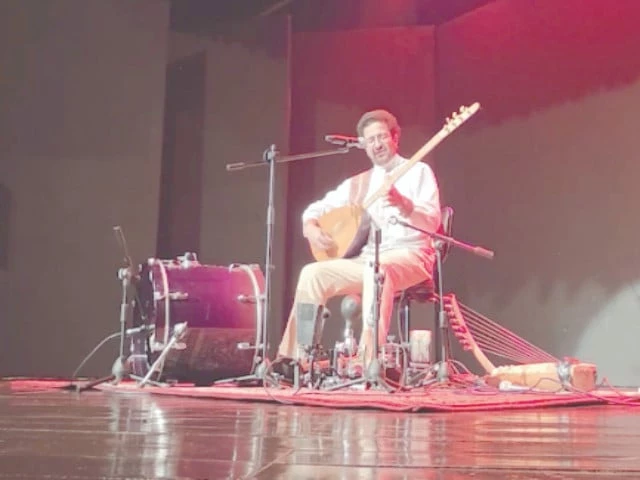
Walking onto the Alhamra Arts Council stage in Lahore, he gave the impression of a one-man museum of traditions, a traveller who believes every instrument carries a geography of its own and every breath contains a trace of history worth protecting.
He opened with the soft, mournful voice of the Armenian duduk, its tone settling over the hall like early dusk. Without pause, he slipped into the airy lilt of a Brazilian wooden flute before turning towards the shimmering mbira of Zimbabwe, each note glittering in the stillness.
From there, he travelled further still, drawing out the deep, earthy resonance of the Gabonese ngombi and later reaching the piercing, poetic lyricism of the Turkish saz, which he played with the steady assurance of someone returning to a familiar friend.
He moved between instruments intuitively, guided by instinct rather than order, adding rhythmic breaths, raw percussive phrasing and raga-inspired tones that floated between cultures without belonging entirely to any.
Geography blurred, borders softened, and the hall leaned into every shift. The audience remained almost completely silent, as if afraid to disturb the delicate transitions. When the final note thinned into applause, it felt as though Alhamra had hosted more than a performance; it had hosted a storyteller who travelled through emotion rather than maps.
Passos, born in Porto in 1977, has spent over two decades tracing musical lineages across Asia, Africa, the Americas and Europe. Before reaching Lahore, he performed at Karachi's World Culture Festival and conducted a workshop at the National College of Arts.
His arrival in Pakistan, though short, became an essential step in what he describes as a lifelong search for the cultural threads that bind global sound. In Lahore, those threads came together, giving the night a sense of completion.
"For me, it began with music," he told the state-run Pakistan TV Digital. "But somewhere along the way, I realised it was leading back to myself." His tone suggested a discovery slowly earned rather than easily claimed.
His journey started late by classical standards. In Portugal, he first played guitar in rock bands before entering a conservatoire to study Western classical piano and guitar. But his world shifted after a teenage trip to Morocco that changed the course of his life.
He still recalls that trip as a moment of inner recognition, saying the pull towards different traditions felt "like a call from the soul" rather than any rational decision. For him, travel became both a musical education and a way of confronting the deeper folds of identity.
He left Portugal in his early 20s and never returned to live there, visiting only for family. The road became his teacher, each country opening a door to another tradition and each instrument deepening his understanding of where sound can lead.
"What came next was never planned," he said in another TV interview in Karachi a few days ago. "Life kept opening the way. I would listen to what arrived, and somehow it all connected. Ancient traditions always felt strangely familiar to me."
His curiosity drew him from Spain to India, and from Turkey to parts of Africa, where he studied instruments often unknown in formal European training. He spent years learning Drupad in India, finding in it a discipline that reshaped his understanding of breath and voice.
That global journey ultimately shaped the eclectic performance he brought to Pakistan. In Karachi, where he arrived for the World Culture Festival, he admitted he had barely seen the city but felt an immediate warmth in the creative environment surrounding the festival.
Although pressed for time, he prepared eagerly for his performance, explaining that he had brought the ngombi, the West African harp he now considers one of his most meaningful instruments. He plans to travel to Gabon next year to study it more deeply.
"People sometimes expect me to play traditional Portuguese music," he said with a grin. "But I don't, even though I am Portuguese. I'm Portuguese out of the box, you can say. My music belongs to the world."
He also expressed admiration for Pakistani instruments, mentioning the dhol with particular enthusiasm. The rubab intrigued him as well, especially after seeing it demonstrated by musicians he met during the festival.
Pakistan, he said, offered him sounds he hopes to explore further in the future. Even in two hurried days, he sensed an openness that matched the curiosity which had shaped his life for more than thirty years.
His upcoming months will take him back to Portugal for performances, then onward to Brazil, and afterwards to whichever country opens its doors next. His schedule, like his music, remains guided by intuition rather than strict planning.
(WITH INPUT FROM NEWS DESK)
Source link